
Your cart
There are no more items in your cart

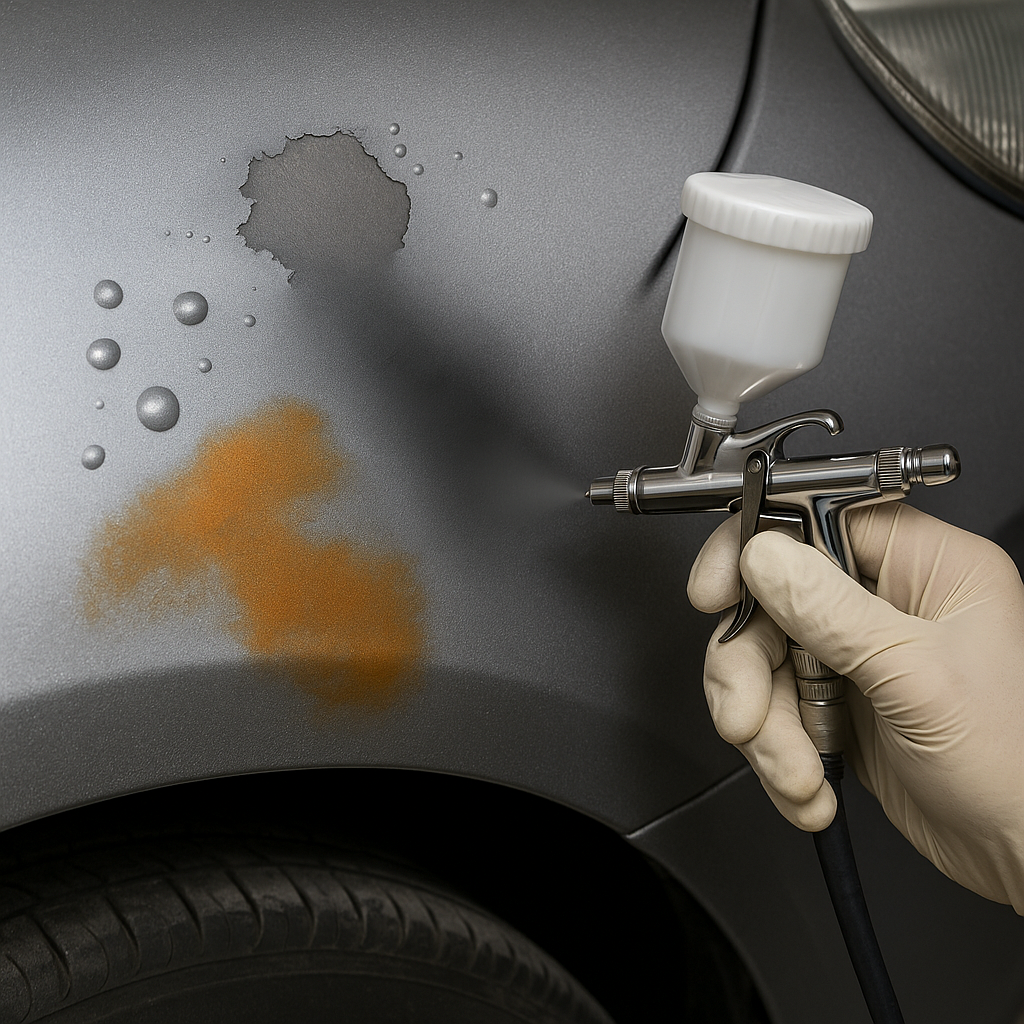
Painting, both in the automotive field and in modeling, is a process as fascinating as it is delicate. Even the most experienced professionals know well that a small oversight is enough to compromise the final result. Bubbles, loss of adhesion, runs, or dull areas are among the most common mistakes, and they often stem from a specific cause: inadequate surface preparation or incorrect use of primer.
In this article, we analyze the most frequent painting mistakes, explaining how to prevent them and how to intervene in case of problems. We will conclude by emphasizing the importance of primer and base quality, fundamental elements for an impeccable finish.
1. Bubbles and Microbubbles in the Paint
Air bubbles are among the most annoying defects because they ruin the uniformity of the surface and, once they appear, they are difficult to eliminate without radical intervention.
Main causes:
- Application of color on a surface that is still wet or contaminated with grease or dust.
- Ambient temperature too high or too low at the time of application.
- Excessive use of pressure or incorrect distance during spraying.
How to avoid them:
- Ensure that the primer is completely dry and compact before applying the paint.
- Always use compatible products: primer, color, and clear coat must belong to the same technology (water-based or solvent-based).
- Maintain working pressure between 1.5 and 2.5 bar, depending on the nozzle and type of product.
How to intervene: If the bubbles are superficial, you can proceed with light polishing and localized touch-up. However, if they affect the base layer, you need to sand down to the primer and repeat the cycle correctly.
2. Loss of Adhesion and Paint Detachment
One of the most serious mistakes is the loss of adhesion between paint layers. It manifests with lifting, cracking, or even detachment of entire portions of color.
Main causes:
- Lack of cleaning or degreasing of the substrate before painting.
- Use of low-quality primer or one not suitable for the material (plastic, metal, resin, etc.).
- Application of the base coat that is too thick or failure to respect drying times.
How to avoid it:
- Always use a universal adhesion primer suitable for every surface, such as Kustomservice water-based acrylic primers.
- Apply primer in light, progressive coats, allowing complete drying between each coat.
- Never accelerate drying with direct heat sources: the surface film dries, but underneath it remains wet and lifts over time.
How to intervene: When detachment occurs, the only professional solution is to completely remove the paint down to the substrate, clean it, and start over with a new complete cycle of primer and color. Attempting to cover the defect only makes it worse.
3. Excess Paint and Runs
A typical mistake, especially among the less experienced, is applying too much product in a single pass. The result is visible runs, thickness differences, and irregular drying times.
Main causes:
- Excessively close distance between airbrush and surface.
- Pressure too high or arm movement too slow.
- Paint not sufficiently thinned for the nozzle being used.
How to avoid them:
- Apply paint with light, crossed coats, respecting flash-off times.
- If working with a 0.2 mm nozzle, thin the product 10 to 20% with dedicated thinner, never with tap water.
- Maintain a constant distance of about 10-15 cm from the surface.
How to intervene: If the runs are minimal, you can wait for complete drying and then gently sand with 1500-2000 grit, polishing afterward. In more serious cases, it's better to remove the affected layer and correctly reapply the paint coat.
4. Surface Defects: Dullness and Orange Peel
Another frequent defect is the so-called "orange peel," an irregular and dull surface that poorly reflects light. Here too, the causes are almost always related to poor application or incorrect parameters.
Main causes:
- Pressure too low or dirty nozzle.
- Paint too dense and not adequately thinned.
- Cold or humid environment that slows drying.
How to avoid it:
- Always clean the airbrush with dedicated cleaner and verify that the flow is constant.
- Maintain ambient temperature between 20 and 25°C with controlled humidity.
- Properly thin the paint (10-20%) and always mix it in a cup, never directly in the airbrush.
How to intervene: Once dry, the surface can be smoothed with fine sanding and refinished with a thin coat of well-thinned paint. If the defect is deep, it's better to remove the layer and repeat the application with correct parameters.
5. The Importance of Adhesion and Base Quality
All the mistakes described have a common denominator: poor adhesion between the various layers of the painting cycle. That's why primer quality and care in the preparation phase are fundamental.
Kustomservice water-based acrylic primer represents today one of the most reliable solutions for those seeking a high-performance universal base. It's ready to use, non-toxic, and designed to adhere to any material — metal, plastic, resin, or wood — guaranteeing a stable base for both water-based and solvent-based paints.
A quality primer not only improves adhesion but also allows for a more homogeneous finish, drastically reducing the risk of bubbles, detachments, or surface defects. It is the starting point of every professional painting job.
Our Considerations
Don't consider painting mistakes as a failure: they are the best school of experience for every body shop worker, modeler, or custom painting artist. Knowing the causes of defects and using high-quality products, such as Kustomservice water-based primers and fillers, is the key to obtaining clean, durable, and repeatable work over time.
Remember: the perfection of a paint job is always born from the base. Good adhesion and a well-applied primer make the difference between an ordinary job and a professional result worthy of the Kustomservice brand.