
Your cart
There are no more items in your cart

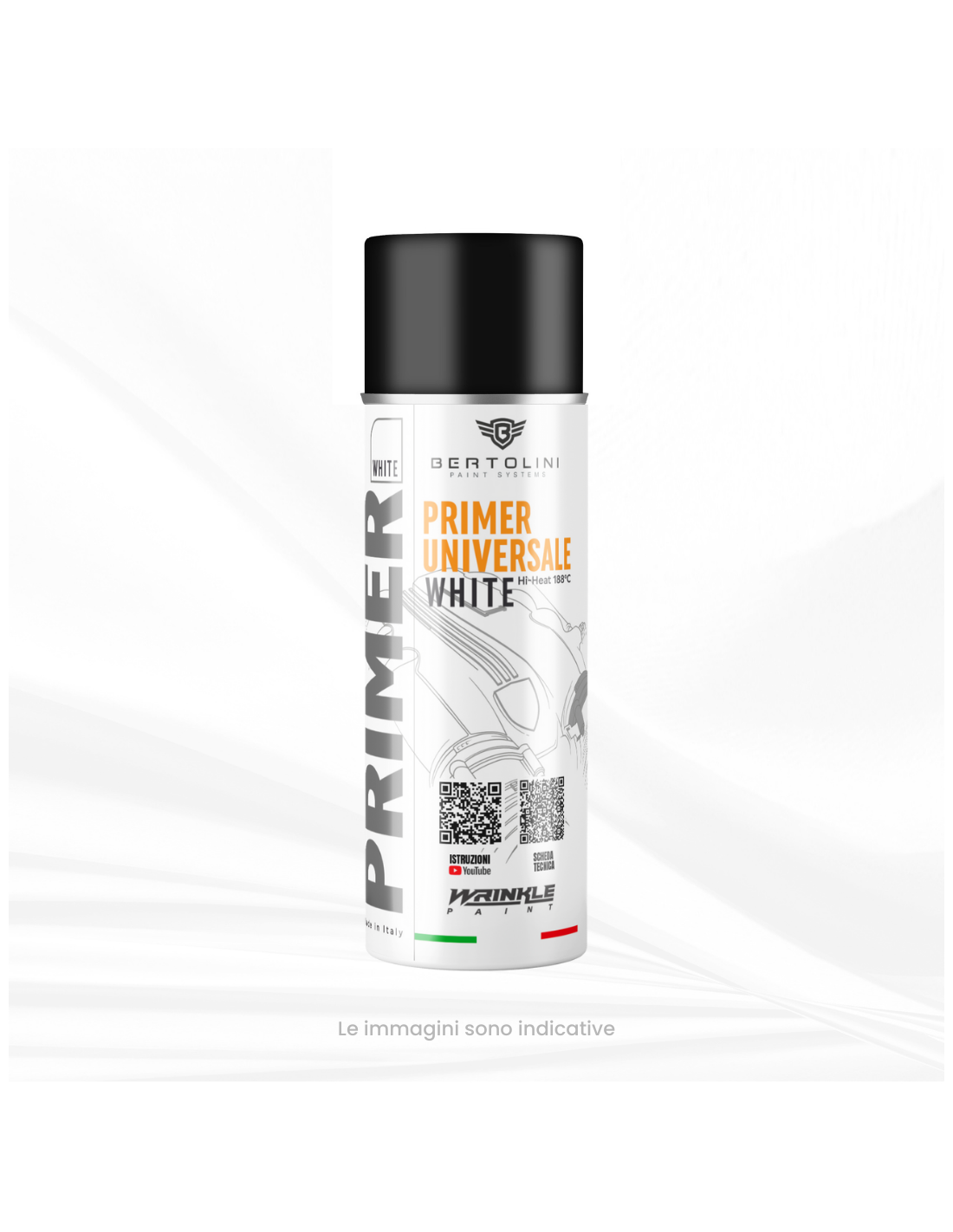
In this article, we will discover what a high-temperature primer is, what it is used for, how to apply it correctly, and why its use is essential to ensure perfect adhesion and superior resistance.
What is a high-temperature primer
A high-temperature primer is a technical base coat formulated to withstand the heat generated by engines and metal components such as brake calipers, manifolds, valve covers, cylinder heads, and in general all parts that reach high temperatures during operation.
In the case of the Kustom Service High-Temperature Engine Primer Spray, we are talking about a professional product developed to:
-
Adhere perfectly to metals, light alloys, and plastics;
-
Withstand heat without deteriorating;
-
Provide high anti-oxidizing power on bare metal, preventing rust formation;
-
Offer the ideal base for engine paints and brake caliper paints.
It is available in spray version for practical and fast use, and in liquid version for those who prefer spray-gun application or need to cover large surfaces.
Why use a primer before engine paint
Many custom painting or mechanical detailing enthusiasts make the mistake of skipping the primer step, believing that paint alone is sufficient.
In reality, it is precisely the primer that makes the difference between an amateur job and a professional one.
Here are the main reasons why you cannot do without it:
Improves paint adhesion
The primer creates a uniform, micro-porous layer that allows the paint to bond perfectly to the substrate, preventing peeling or cracking over time.
Protects metal from oxidation
Metals, especially when exposed to heat, are subject to oxidation. The primer acts as an anti-corrosion barrier, blocking the action of moisture and chemical agents.
Ensures durability and resistance
Using a high-temperature primer significantly improves the resistance of the coating to fuel, oils, solvents, and aggressive washing.
Essential for special colors
Fluorescent colors, for example, activate only on white bases: without the correct primer, the final effect would appear dull and uneven.
When and where to use high-temperature primer
High-temperature engine primer is designed for all metal and alloy surfaces commonly used in engines and braking systems.
It is ideal for:
-
Cylinder heads and valve covers
-
Engine blocks
-
Brake calipers
-
Exhaust manifolds
-
Metal supports and brackets
It can also be applied to rigid plastics, provided they are heat-resistant and properly degreased.
⚠️ Warning: do not use the primer on magnesium alloys, as it is not compatible.
How to apply the primer correctly
The preparation phase is what determines the success of the entire job.
Even the best primer cannot perform miracles if the surface is not perfectly clean, degreased, and dry.
Below is the step-by-step procedure recommended by Kustom Service, valid for both spray and liquid versions.
1. Part preparation
Always wear latex gloves: skin contact with metal can leave invisible grease traces that compromise adhesion.
Thoroughly clean the surface with Kustom Service Aeronautical Degreaser, specifically formulated to remove oily residues and contaminants.
Avoid using common or household degreasers: they may contain silicones or substances that inhibit paint adhesion.
2. Primer application
Shake the spray can or liquid primer container well to properly mix the components.
Apply a first light and even coat.
Allow to dry for 10 minutes.
Then apply a second, heavier coat to fully cover the surface.
Wait 30 minutes at room temperature.
After this time, you can proceed with final painting without sanding the primer.
3. Pay attention to timing
If more than 60 minutes pass after primer application, before painting it is necessary to scuff the surface using a gray 3M Scotch-Brite pad.
This helps restore optimal paint adhesion.
4. Final painting
At this point, the part is ready to receive any Kustom Service high-temperature paint.
The primer will act as a stable and resistant anchor, improving both aesthetic appearance and long-term durability.
Common mistakes to avoid
Many jobs are compromised due to simple mistakes in the initial phase.
Here are the most frequent errors:
-
Not properly degreasing the metal before applying primer;
-
Applying too many coats of primer, creating excessive thickness;
-
Painting too soon without respecting drying times;
-
Touching the part with bare hands after cleaning;
-
Using universal primers that are not heat-resistant.
A quality high-temperature primer like Kustom Service’s is formulated to withstand temperatures above 200°C, ensuring stability, adhesion, and long-term protection.
Professional tips for a perfect result
-
Clean and dry environment: dust ruins the finish.
-
Ideal temperature: apply primer between 15°C and 25°C.
-
Spray distance: about 20–25 cm to avoid runs.
-
No rush: the more uniform the base, the more even and durable the final paint.
-
Check the final effect: after complete drying, inspect the surface under reflected light—it should be matte and uniform, a sign of a perfect base.
Conclusion: the secret of perfect painting starts with the primer
Every professional painting job — whether on Harley-Davidson engines, sporty brake calipers, or light alloy parts — starts with one golden rule:
preparation is everything.
The Kustom Service High-Temperature Engine Primer is not just a base coat, but a guarantee of durability and quality for any painting cycle.
Using it correctly means achieving:
-
Better paint adhesion;
-
Smoother and more uniform surfaces;
-
Long-lasting anti-corrosion protection;
-
Resistance to fuel, solvents, and heat.
Remember: the more accurate the preparation, the more spectacular the final result.
Recommended product
High-Temperature Engine Primer Spray – Kustom Service
Discover the product in our shop
The professional primer for those who demand the maximum from their paintwork.